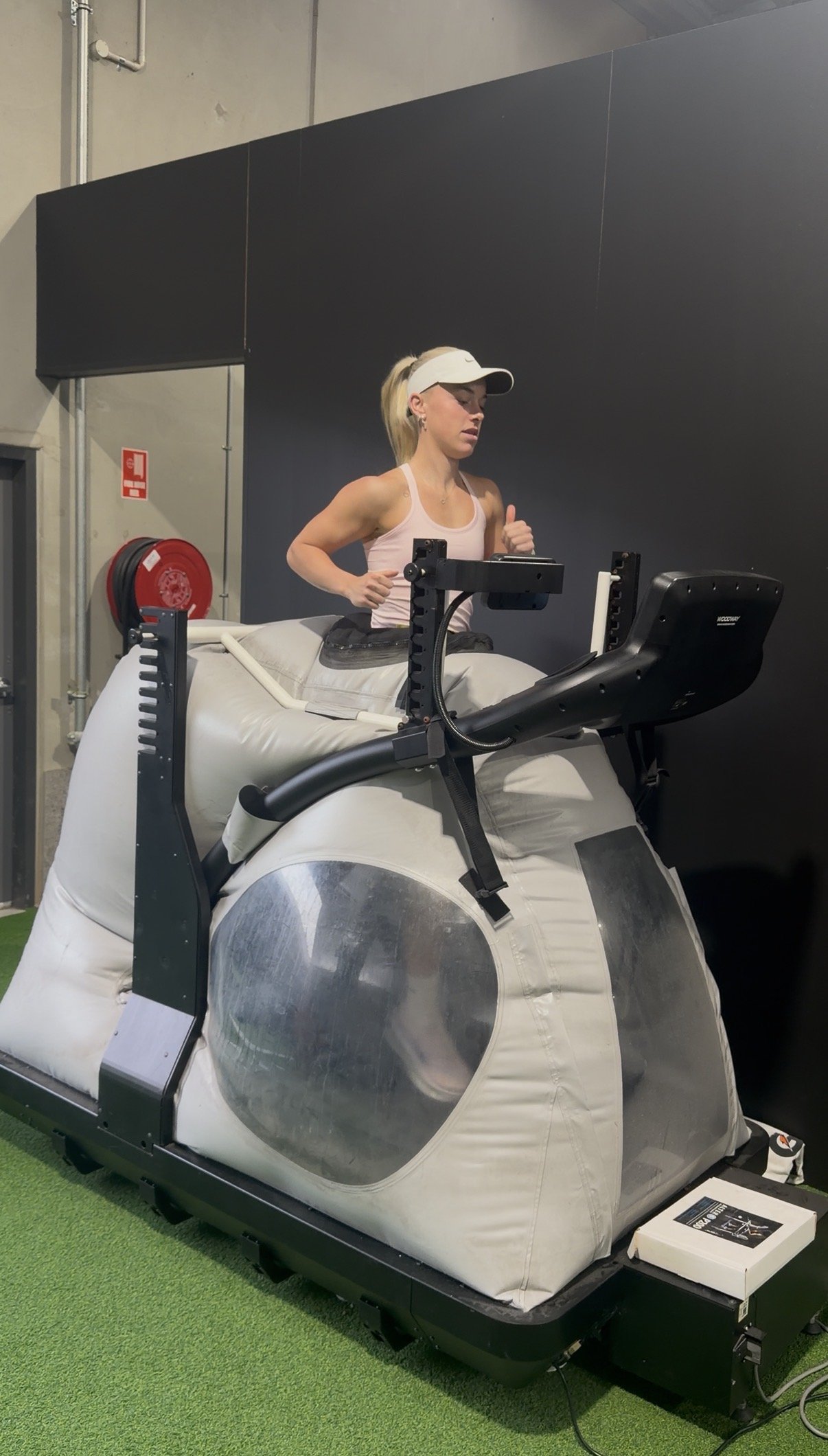
The Anti-Gravity Treadmill: How It Works and When We Use It
By Dan Greenslade, October 2026
A key milestone in any rehabilitation journey is when the physio grants the green light to return to running. An anti-gravity treadmill lets us reintroduce running earlier in rehab by using air pressure to reduce the body weight you carry, so injured tissue is loaded gradually instead of all at once. They’re used with athletes and everyday runners recovering from lower-limb surgery such as an ACL reconstruction or syndesmosis injury, as well as bone stress injuries and other conditions where full-impact running isn’t yet appropriate.
What is an Anti-Gravity Treadmill?
An anti-gravity treadmill is a treadmill inside an air-filled chamber which uses air pressure technology that was originally developed at NASA. You wear sealed shorts, and air pressure lifts you, so your legs carry less of your body weight. The load can be set anywhere from 100% down to 20% of your body weight.
You may also hear these treadmills called microgravity or zero-gravity treadmills, or by brand names such as the Alter G or the Boost. They all refer to the same type of equipment. Some of these names are brand names and others are general terms, and at iPerform we use the Boost.
Why do we use it?
Less body weight means less force through the legs. This means we can gradually expose the body and areas that have been injured to the demands of walking or running at a lighter load. By fluctuating both the running speed and percentage of body weight, we can control how much load a healing injury is exposed to. As we progress through the sessions, we increase the body’s demands to ensure you are physically prepared to return to outdoor running. In addition, fear of re-injury is common when returning to running. Running pain-free in a controlled setting like the anti-gravity treadmill gives you the chance to trust the injured area and gain confidence in your movement cadence.
You may begin running at 65-70% body weight on the anti-gravity treadmill, where the load through the injured area is significantly reduced. As your control and confidence improve, we gradually increase the load. Once you can run pain-free with normal mechanics at 85-90% body weight, you’re ready to progress to outdoor running.
What does the research say?
The research highlights the benefits of using an anti-gravity treadmill. One study shows that athletes who used an anti-gravity treadmill after Achillies reconstruction ran outside on average at 18 weeks compared to 20 weeks without using an anti-gravity treadmill. In a 73-patient ACL study, a 6-week anti-gravity treadmill program in early rehab was linked to less thigh muscle wasting (50% vs 19% with no leg difference) and a higher return-to-sport rate at one year (72% vs 43%).
Anti-Gravity vs Other Options
Deep Water Running
Deep water running takes all the impact out, and one study found it matched treadmill running for oxygen use and energy burn at moderate-to-hard efforts. The catch is your muscles fire a bit differently in the water, so it’s not a perfect substitute for running on land. The anti-gravity keeps you running with less load
Bike
Both using the bike and an antigravity treadmill should be used together. The bike takes the lead for conditioning, letting you train your energy systems with low impact going throug the legs. The anti-gravity treadmill is where you work on running mechanics and teach the body to absorb force again, since studies show impact forces drop as you add support, so you can rebuild the pattern without the full hit.
Delaying Return to Run
Delaying the RTR process and having the first run outdoors can cause some issues which is exactly why we can use the anti-gravity treadmill. With the anti-gravity treadmill you can start running earlier less impact through your legs.
Who is it for?
The anti-gravity treadmill is mainly a rehab tool for people who need to reduce the load through their legs while building back up to walking or running. It’s commonly used for tendon and overuse injuries, bone stress injuries and fractures, and after surgery such as ACL reconstruction, meniscus repair, ankle reconstruction and hip arthroscopy.
Conclusion
The anti-gravity treadmill gives us a way to bring running back earlier and in gradual increments, so your body is prepared for outdoor running. At iPerform in Edinburgh, we can use the Boost as part of lower limb rehab for everything from tendon and bone stress injuries to post-surgical recovery. If you want to know whether it fits your plan, book a physio appointment or find out more about the Boost by clicking the link below.