
Got A Sore Shoulder After a Hard Knock? It Might Be Your AC Joint
By Kaiden Coats, September 2026
Your shoulder's been sore since that knock, and it's not settling down? You might be dealing with an acromio-clavicular (AC) joint injury, commonly caused by a hard tackle, a fall onto an outstretched hand, or landing straight onto the point of the shoulder. The good news? Most AC joint injuries heal well without surgery, and understanding what's going on is the first step toward getting back to what you love.
What is the AC Joint?
The AC joint sits at the very top of your shoulder, where your collarbone meets your shoulder blade.
Although it's a relatively small joint, it plays a big role in helping your shoulder move efficiently, particularly when reaching overhead, lifting, pushing, or performing sporting movements.
How Do AC Joint Injuries Happen?
AC joint injuries almost always occur following a direct impact to the shoulder. Common sporting activities that cause injury include:
A heavy tackle/bump during football
Fall on an outstretched hand - being knocked to the ground.
Slipping and landing on the point of your shoulder
The force stretches or tears the ligaments that stabilise the joint, leading to pain and, in some cases, joint gapping which may present as a noticeable bump on top of the shoulder.
What Does an AC Joint Injury Feel Like?
Symptoms can vary depending on the severity of the injury, but you might notice:
Pain directly on top of the shoulder
Swelling or bruising
Pain when reaching across your body or overhead
Difficulty lifting, pushing or carrying
Tenderness when touching the top of the shoulder
A visible bump/step deformity in more significant injuries
If you're experiencing shoulder pain after heavy contact/fall, it is worth following up with a health professional to get an assessment. Unsure? Call us on 8151 1347 or click HERE to book in with one of our physiotherapists who can help you work out what your shoulder needs.
Understanding the Types of AC Joint Injury
AC joint injuries are graded from TypeI to VI based on how much damage has occurred to the supporting ligaments and how far the collarbone has shifted out of position.
Type I: A mild sprain of the AC ligaments with no visible deformity. The joint remains stable, though it's often tender to touch.
Type II: A partial tear of the AC ligaments, with some stretching of the coracoclavicular (CC) ligaments too. There may be slight instability and mild step deformity.
Type III: A complete tear of both the AC and CC ligaments, causing a noticeable bump or step where the collarbone sits higher than the shoulder blade. The joint is unstable, but many people still recover well without surgery.
Type IV: Similar to Type III, but the collarbone is displaced backward into or through the surrounding muscle, causing more significant instability.
Type V: A more severe version of Type III, with much greater separation between the collarbone and shoulder blade. This usually causes a very prominent deformity and often needs surgical review.
Type VI: Rare and severe. The collarbone is displaced downward, below its normal position. This typically requires surgical management.
See the image below for a visual representation for the different types of AC joint injuries.
Do All AC Joint Injuries Need Surgery?
The majority of injuries (Type I and II) recover extremely well without surgery. Even many Type III injuries can be successfully managed with physiotherapy, particularly if your goal is returning to work, the gym, or recreational sport.
More severe injuries (Type IV-VI) are less common and often require review by a sports doctor or orthopaedic surgeon.
How Can Physiotherapy Help And How Long Does Recovery Take?
Your rehabilitation is guided through four key phases: pain and symptom management, restoration of range of motion, progressive strength and load development, and return to function and sport. Your physiotherapist will progress you through each phase based on clinical assessment of your shoulder. Recovery depends on the severity of the injury, your previous strength and mobility, how well you respond to early treatment, and the demands of your sport.
As a general guide:
Type I: Around 2-4 weeks
Type II: Around 4-8 weeks
Type III: Often 8-12 weeks or longer
Type III - VI (surgically managed) - 12 weeks+
Everyone recovers at a different pace, so timelines can vary. Returning to contact sport should always be guided by your symptoms, strength, and function. Your physiotherapist will continue to assess your shoulder throughout your rehabilitation and using VALD equipment can help you make data informed decisions about return to play.
The Bottom Line
AC joint injuries are common, especially in contact sports and after falls, but they don't always mean surgery or months on the sidelines.
An early assessment can help determine the severity of the injury, provide reassurance, and get you started on the right rehabilitation plan. With progressive loading and a structured return to activity, most people can get back to doing what they love with confidence.
If you've recently injured your shoulder or you're still dealing with pain weeks after a fall, book an appointment with one of our physiotherapists. We'll help you understand what's going on and build a plan to get you moving again.
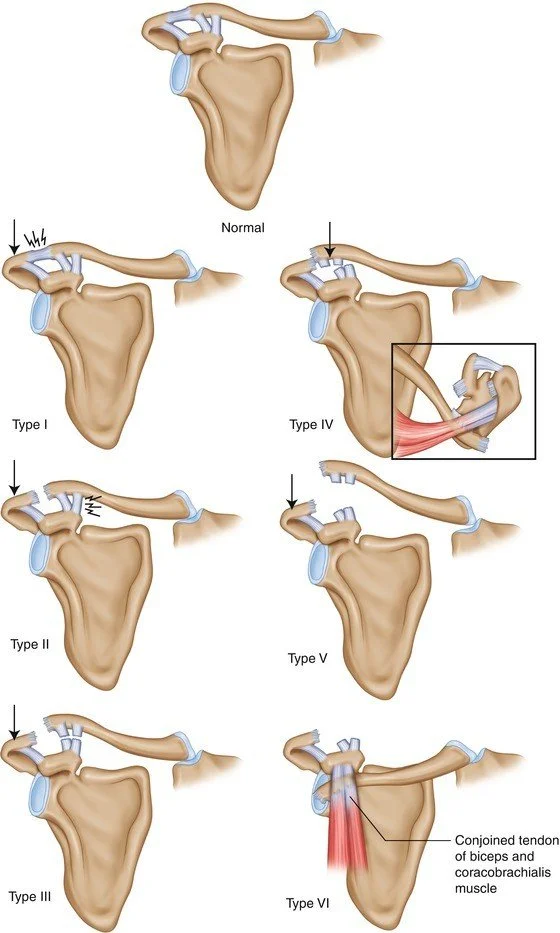
Image source:
White, S., Pearsall, A. (2017). Acromioclavicular Joint Separation. In: Eltorai, A., Eberson, C., Daniels, A. (eds) Orthopedic Surgery Clerkship. Springer, Cham. https://doi.org/10.1007/978-3-319-52567-9_13